

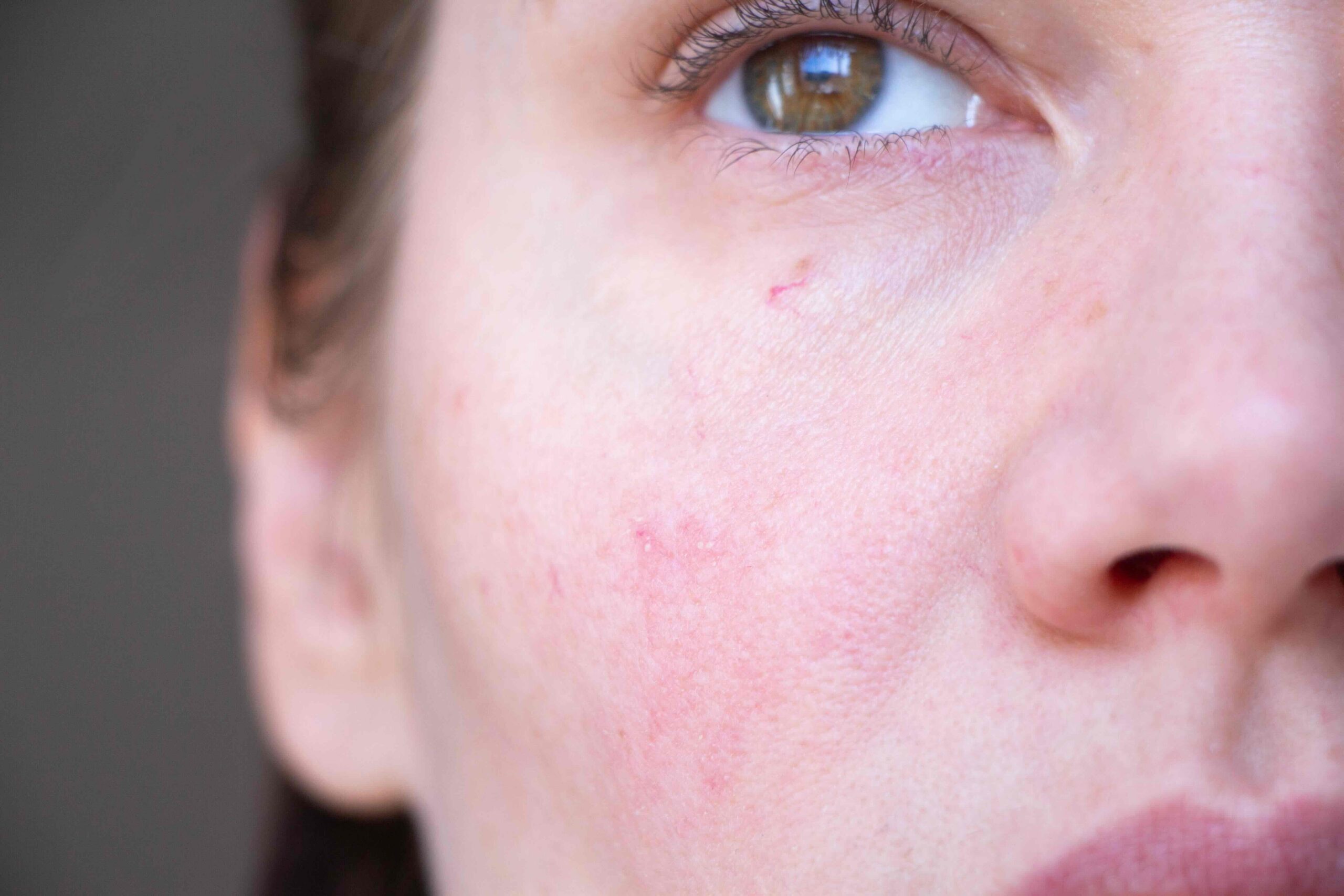
Have you noticed delicate reddish or purplish lines on your cheeks, nose, or chin that don’t fade away? Or perhaps you’ve noticed fine dilated capillaries on your thighs or calves?
These are visible capillaries or perhaps dilated superficial blood vessels, which in medical terminology are called telangiectasias.
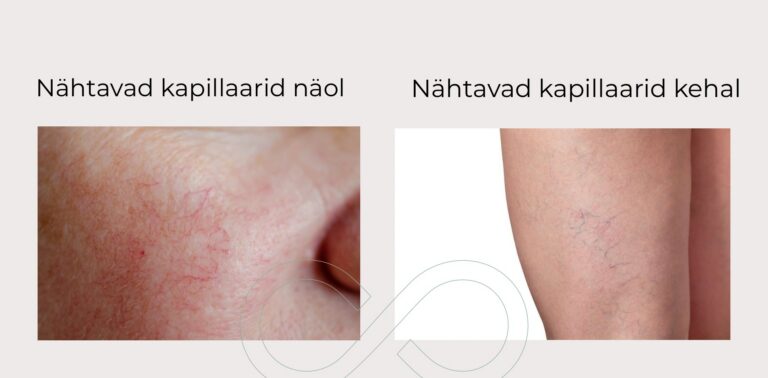
Visible capillaries are very common – both on the face and the legs. Although they do not pose a health risk on their own, they can affect self-esteem and the overall appearance of the skin. Some people consider them merely a cosmetic problem, while for others they may be a sign of skin hypersensitivity or a chronic condition such as rosacea.
Good news is that today there are several effective solutions to reduce or make capillaries almost invisible.
Why do dilated capillaries become visible?
Visible capillaries appear when the small blood vessels under the skin expand and remain permanently open. Normally, these blood vessels are microscopic and invisible to the eye, but when their walls weaken or they dilate excessively, they begin to show through the skin.
Here are the main reasons why capillaries become visible:
1. Genetic predisposition
If there are many capillaries on the face or legs in the family, it is likely that your skin is also more susceptible to them. Thin skin (especially with age) and light skin make capillaries even more noticeable.
2. Effects of the sun and UV radiation
UV radiation damages the skin and the walls of blood vessels. Over the years, blood vessels become more fragile and expand, which can lead to persistent redness and visible capillaries. Repeated sunburns over a lifetime break down the skin’s collagen, reducing the support for capillaries and causing them to remain permanently visible.
3. Hormonal changes
Pregnancy, menopause, and hormonal fluctuations can promote the dilation of blood vessels, particularly in the legs and face. During pregnancy, the volume of blood in a woman’s body increases, which raises the pressure on the capillaries, making them more visible on the thighs or other areas.
4. Blood circulation and pressure on foot vessels
Standing or sitting for long periods increases pressure on the leg vessels. This is why many people notice capillaries on their thighs and calves. For example, people who must stand for long periods due to the nature of their work (hairdressers, service workers, etc.) develop leg swelling, which can cause capillaries to become loose over time and remain dilated.
5. Lifestyle and habits
Smoking, excessive alcohol consumption, too hot saunas or spicy foods can stimulate rapid vasodilation, which over time makes capillaries more visible. Smoking damages the inner lining of blood vessels and reduces oxygen supply to the skin. This weakens capillary walls and accelerates skin aging, while alcohol consumption causes blood vessels to temporarily dilate – with repeated exposure, they may become permanently visible.
6. Age and loss of skin elasticity
With age, the amount of collagen and elastin in the skin decreases. Without these supporting structures, the blood vessels lose support and begin to protrude more.
Review article published in 2015 in the journal Journal of Clinical and Aesthetic Dermatology Confirming that chronic sun exposure and a reduction in collagen are the primary factors that make superficial capillaries more visible. Source
When should you consult a specialist due to enlarged capillaries?
Visible capillaries are usually not dangerous, but sometimes they can be a sign of a deeper problem or cause discomfort severe enough to warrant a visit to a specialist.
Contact a specialist if:
-
Capillaries appear suddenly and rapidly;
-
Redness is not limited to small blood vessels but spreads more widely (e.g., across the entire cheek or nose).
-
visible capillaries are accompanied by pain, tingling or swelling;
-
The skin is inflamed or pimple-prone in addition to redness (may indicate rosacea). If you suspect rosacea, here I wrote more;
-
Capillaries occur at a young age for no obvious reason;
-
Legs with visible capillaries are accompanied by heaviness, swelling, or pain (may indicate deeper vein problems and should be consulted with a general practitioner first).
If you are concerned about the appearance of your capillaries or the development of new ones, it is always advisable to start with a consultation. A specialist can assess whether these are merely superficial changes or if the condition requires more thorough examination and treatment.
How to remove or reduce the enlarged capillaries?
I’ve prepared a convenient table for you that you can save on your phone to refer to later if needed.
Home steps to relieve visible capillaries
Every-day simple habits help reduce the formation of new capillaries and support the overall condition of the skin.
| Step | Why is that helpful? | Tip |
|---|---|---|
| Sunscreen | Protects capillaries from UV-radiation damage and prevents the formation of new ones. | Use SPF 30+ broad-spectrum sunscreen every day, even on cloudy days. |
| Gentle skin care | Reduces irritation and strengthens the protective barrier of the skin. | Avoid rough peelers and alcohol-containing tonics. |
| Lifestyle choices | It affects the health and stability of blood vessels. | Limit alcohol and smoking, avoid very hot baths. |
| Support for foot veins | Improves blood circulation and reduces pressure on leg capillaries. | Compression stockings can be helpful if the capillaries are visible on the calves or thighs. |
The clinic offers solutions for visible capillaries.
Professional procedures are more effective because they work directly at the capillary level.
| Solution | How does it work? | Note |
|---|---|---|
| IPL (intensity pulsating light) | Targeted light flashes heat the capillary, which recedes over time. | It is good for redness and smaller capillaries. |
| Laser procedures | Laser energy affects deeper or stronger blood vessels. | It is also effective with foot capillaries. |
| Calming maintenance | Reduce redness and strengthen the protective barrier. | Can be combined with IPL or laser. |
| Personal maintenance plan | It combines home and professional solutions. | Prepare according to the condition and sensitivity of the skin. |
I also highlight some common myths about visible capillaries.
The capillaries will disappear on their own.
In fact, visible capillaries are permanent if their walls have already expanded. They do not disappear on their own, but with the right care and procedures, they can be significantly reduced or made less noticeable.
“Cremes remove capillaries.”
No cream can ‘close’ or ‘erase’ capillaries because this is a vascular change inside the skin. However, the right skincare products can strengthen the skin, reduce redness, and prevent new capillaries from forming.
Capillaries only occur at an older age.
Although aging increases the risk, capillaries can appear in younger people as well. Genetic predisposition, pregnancy, sun exposure, or lifestyle habits can trigger them even at a young age.
Visible capillaries are always a disease.
Mostly this is a cosmetic problem, but sometimes it can also indicate rosacea or venous problems in the legs. That’s why it’s worth consulting a specialist to determine the cause.
 Kadaka tee 42b, 12919 Tallinn II korrus
 E-R 09.00 — 17.00
 info@n8r.ee
 +372 59009272