

What are acne scars
Acne scars are scars that remain on the skin after more severe acne has healed. If the inflamed pimples damage the skin layers deeply enough, the body replaces the damaged tissue with scar tissue. The result can be uneven pits (atrophic scars) or, less commonly, slightly raised tissue (hypertrophic scars). In addition to scar tissue, acne can also leave behind dark spots, but these are more likely to be temporary. pigment marks (post-inflammatory hyperpigmentation), not real scars.
Types of window scars
- Atrophic scars: These are the most common acne scars. They are divided into:
- ‘Ice pick’ scars: narrow, deep holes in the skin, like needle sticks.
- Rolling scars: Wavy depressions in the skin that give the skin an uneven appearance.
- ‘Boxcar’ scars: Sharp-edged depressions, round or oval (similar to chickenpox scars).
- Hypertrophic and keloid scars: These occur less frequently after acne, mostly on body areas (e.g., chest, shoulders). Scar tissue grows beyond the wound boundaries, forming a raised bump as a scar.
Effect of window scars
- Aesthetic and psychological aspects: Acne scars can affect self-confidence – uneven skin texture is visible under makeup and it is difficult to achieve a smooth complexion. Many feel uncomfortable with acne scars even years after acne has disappeared.
Treatment options for acne scars
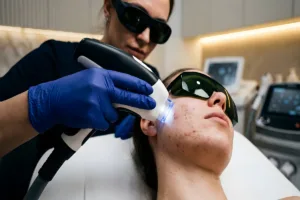
- Laser grinding: Fractionated laser (e.g., CO2 or erbium laser) creates controlled micro-damage in the skin, stimulating the production of new collagen. This helps treatment of acne scars Fill wrinkles from the inside and smooth the skin’s surface.
- Microneedling and PRP: Microneedling (often combined with platelet-rich plasma) punctures the skin with tiny needles, triggering the skin’s healing process. New collagen and elastin make scars shallower and the skin texture smoother.
- Chemical peelings: Deeper chemical peels (TCA peels, phenol peels) can help reduce the depth of scars by exfoliating the top layers and stimulating the growth of new smooth skin.
- Filler injections: Some deeper wrinkles can be temporarily filled with hyaluronic acid or collagen to make the skin’s surface more even. This does not remove the scar but improves the appearance for a while.
- Surgical techniques: In cases of very deep ice pick scars, punch excision (a small incision to remove the scar) or subcision (releasing the subcutaneous tissue of the scar) may be used to allow other methods to be applied. These are more suited to severe cases.
Prevention of scarring in acne
- Early acne treatment: The best way to prevent scars is to treat acne quickly and effectively. The less and shorter the skin is deeply inflamed, the lower the risk of scarring.
- Do not squeeze: Squeezing or picking at pimples and cysts significantly increases the risk of scarring. It is better to leave the cleaning to a professional (a beautician or a dermatologist).
- Skin care after acne: Even if acne has subsided, continue with skin-smoothing and collagen-supporting treatments (e.g., retinol, vitamin C), which may slightly even out skin texture over time.
If acne scars have left their mark on your skin, there are effective solutions to help reduce their appearance. Contact our clinic or Book an IPL Acne Treatment Procedure– Let’s find the most suitable method together to make your skin texture smoother and improve your comfort.
 Kadaka tee 42b, 12919 Tallinn II korrus
 E-R 09.00 — 17.00
 info@n8r.ee
 +372 59009272