

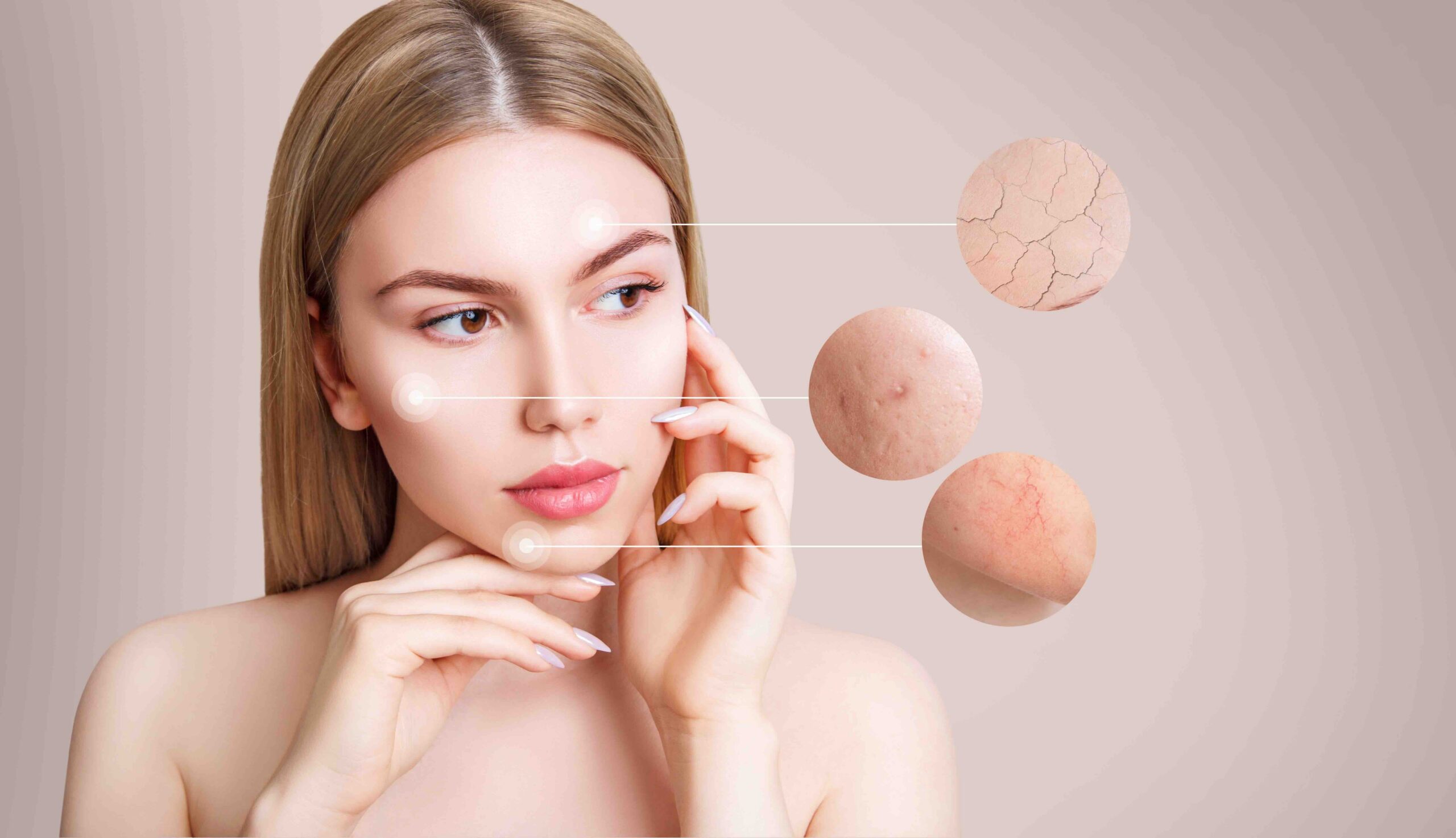
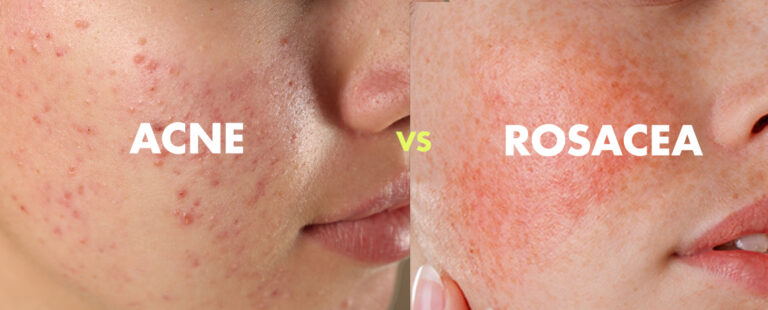
People often confuse acne and rosacea, which is understandable as both can present with redness and bumps.
But their origin, course and treatment are completely different.
Incorrect skincare (such as harsh acne treatments or retinoids) can irritate the skin and worsen rosacea.
If you frequently experience red bumps, irritation, or warm patches on your face, it may be time to pause and consider:
Could this be acne, rosacea, or a combination of both?
Next, I explained how to better distinguish between these two conditions and what we as aesthetic medicine specialists can do to treat and alleviate them.
Acne vulgaris (common acne)
Acne is a skin condition that occurs when, simply put, the skin becomes blocked — with sebum, dead skin cells and bacteria. This blockage often leads to inflammation. Acne is characterized by:
-
open or closed comedones (blackheads/whiteheads)
-
inflammatory papules or pustules, commonly referred to as ‘pimples’, and sometimes cystic formations
-
oily skin or increased sebum production
-
it often occurs on the back, chest or shoulders — not just the face
There are several causes of acne: genetics, hormonal fluctuations, bacteria, sebaceous gland activity, and pore blockage.
Here is a scientific source that provides a more detailed explanation of acne: Source
Acne treatment and care focus on stopping excess sebum production, cleaning pores, and reducing inflammation.
Rosacea
Rosacea is not acne but chronic inflammatory condition, which focuses on vascular changes and skin dysfunction.
Main features:
-
Persistent or recurrent facial redness — often on the cheeks, nose, chin, and forehead.
-
visible superficial vessels or red capillaries
-
Inflamed red papules or pustules — may resemble acne, but without comedones (no black or whiteheads).
-
often involves skin sensitivity, tingling, dryness or burning.
In rosacea, the primary issue is not sebum or clogged pores, but disorders of the skin barrier function, excessive vascular reactivity, and inflammatory processes.
Acute rosacea may last longer (chronic) and tends to recur over time — exacerbations and remissions.
I also have a scientific article on rosacea: Source
One review article emphasizes that the etiology of rosacea and acne is fundamentally different: in acne, the role of pore obstruction, bacteria and sebum is involved — in rosacea, the inflammatory response of blood vessels. Article reference
Simple test: acne or rosacea?
I have compiled a simple test with initial questions that you can ask yourself if you suspect either skin problem. But note that an accurate diagnosis cannot be made based on these questions and if you want to start treating your skin condition, you should definitely consult a dermatologist or specialist first who can correctly assess the situation and is competent to make a diagnosis and prescribe treatment.
If you answer “yes,” it’s likely to be rosacea:
-
Does the skin itch or is it painful even when applying a light cream?
-
Does redness worsen after exposure to heat, cold, alcohol, stress or exercise?
-
Do pimples mainly appear on the cheeks, not the chin and forehead?
-
Does your skin feel irritated and dry at the same time?
If you answer “yes” rather than “yes” to them:
-
Are there blackheads or comedones?
-
Is the skin oily or shiny?
-
Do inflammatory pimples appear in the chin and forehead area?
Of course it’s possible. Acne + rosacea combined variant — this is very common and requires a more precise approach, as I mentioned earlier, so to correctly identify the problem, you should definitely consult a specialist to establish a correct treatment plan.
When does the rosacea “exaggerate”? (and why does it happen)
An exacerbation of Rosacea means that the skin changes at one point:
-
redder
-
more sensitive
-
stingy
-
It’s coming out with a little reddish lump.
Typical factors that exacerbate rosacea:
-
cold weather, wind, temperature fluctuations
-
hot sauna
-
stress
-
Alcohol (especially red wine)
-
spicy food
-
too strong acids or retinol
-
wrongly selected cosmetics
The heightened phase needs pacification, not products for drying or acne.
Why can acne treatment make rosacea worse?
This is one of the most typical mistakes.
Anti-acne products (acid exfoliants, retinoids, drying gels) may:
-
break the skin barrier
-
aggravate redness
-
create a burning sensation
-
cause new bulges
How do we calm rosacea in the clinic?
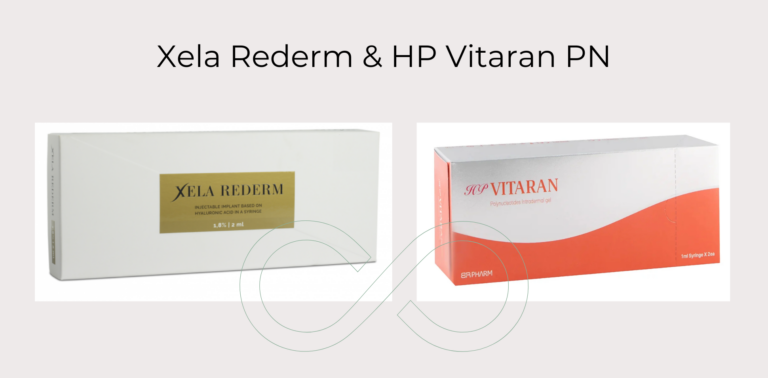
1️ne Xelarederm – an intense skin barrier restorer
Xelarederm is designed to restore irritated and sensitive skin.
It consists of:
-
dexpanthenol (soothes)
-
niacinamide (reduces redness)
-
Ceramides (restoring the barrier)
In the case of Rosacea, the barrier is almost always weakened.
If the barrier is strengthened, redness and inflammatory reactions also decrease.
We use Xelarederm frequently:
-
in case of exacerbation of rosacea
-
procedures that can cause redness
2️v Vitaran polynucleotides (PN) — deeper supportive treatment
Polynucleotides are among the most effective skin soothers and restorers we can use in aesthetic medicine.
What PNs do for rosacea:
-
reduce inflammation
-
improve skin irrigation
-
reinforce the barrier
-
Reduce redness over time
-
make the skin more tolerant (less tingling and irritation)
Vitaran PNs are particularly suitable:
-
sensitive skin
-
after exacerbation of rosacea
-
To reduce redness and irritation
-
to improve overall skin tolerance
- We use them mainly also to reduce dark circles under the eyes
These are not fillers but injections that restore the skin and its protective barrier, helping the skin to calm down.
Summary: Acne and rosacea are different — and require a different approach
Acne requires pore cleansing and sebum regulation, sometimes also medication.
Rosacea requires calming, stabilizing blood vessels, and strengthening the skin barrier. Dermatologists may prescribe a treatment cream depending on the severity of the condition.
If you’re unsure which condition you have, this is completely normal—we see this every day.
The correct approach begins with an accurate diagnosis.
We will examine your skin together and choose a solution that is correct, effective, and safe for your skin.
For both skin problems, the primary and most important component is to protect the skin barrier. I wrote more about this in one of my other blog posts. “Skin Protective Barrier: What Is It and How to Restore It?”
In addition, I have previously written in-depth about rosacea: “Rosacea – Causes, Symptoms and Effective Solutions.”
 Kadaka tee 42b, 12919 Tallinn II korrus
 E-R 09.00 — 17.00
 info@n8r.ee
 +372 59009272