
When discussing skin renewal and preventing signs of aging, one active ingredient stands out from the rest — Vitamin A and its derivatives, known by their common name retinoids down.
There’s a lot of confusion here:
product signs speak once retinol, order retinoid or retinal, sometimes even retinoleic acid or retinyl esters.
Are they all the same thing?
It’s not.
They all belong to the same family, but they different strength, transformation process and effects on skin.
When talking about anti-age Among anti-aging ingredients, one name always stands out — retinol.
But if you look at the labels of skincare products, you’ll also find words like retinos, retinal, retinoleic acid and even retinyl esters.
Many people think they mean the same thing, but they actually refer to different things Vitamin A derivatives of different strengths and modes of action.
In terms of aesthetic medicine, vitamin A is one most thoroughly examined active ingredient in the fields of skin rejuvenation, collagen stimulation, and acne treatment.
Why is that even important?
Vitamin A is one of the most studied substances in dermatology.
2016 Review Study in the Journal Dermatology and Therapy confirmed that the retinoids are ‘Gold standard in the prevention and support of skin photoaging, as they directly affect gene activity in cells, stimulate collagen production, and accelerate skin renewal.
In the following, How Retinoids Work in the SkinWhy and how their strength differs and how to choose the right form for your skin.
What is a retinoid?
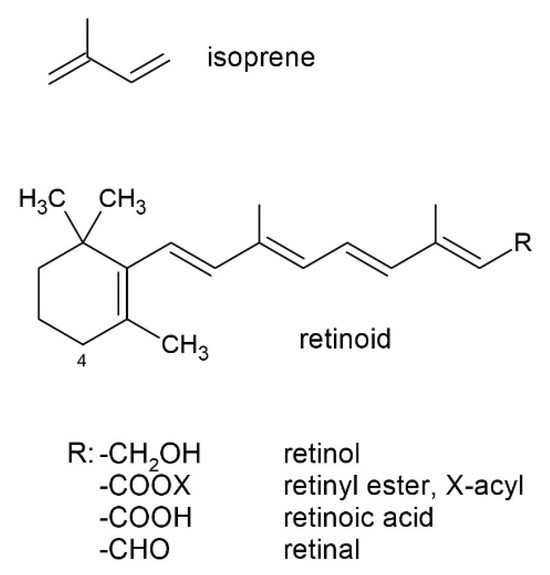
Retinoid is a general term for all compounds of vitamin A and its derivatives (i.e., chemical forms).
In other words, retinol, retinal and retinoleic acid all retinoids.
The Retinoid family includes:
-
natural forms (retinol, retinal, retinoleic acid, retinyl esters)
-
synthetic Formulations such as adapalene, tazarotene, and isotretinoin (used in medical treatments, including for acne).
In simple terms:
All retinols, retinals and retinole acids belong to the retinoid family.
So if someone says “I use a retinoid”, it could mean either:
-
cosmetics containing retinolor
-
prescription retinoid (e.g. tretinoin, adapalene) from dermatological treatment.
-
Biochemical chain:
Retinoid transformation occurs in the skin only in one direction — weaker → stronger:
Retinoyl Esters → Retinol → Retinal (Retinaldehyde) → Retinoic Acid
And only retinoleic acid this is the form that actually works on the skin’s cellular receptors and triggers a biological response (collagen production, cell division, pigmentation regulation, etc.).
This is why science states that all other forms are so-called precursors that must be converted into retinoic acid in the skin.
The more stages a substance has to undergo, the weaker and gentler effect but also reduced risk of irritation.
For example, the 2017 review study in the journal Journal of Dermatological Treatment It describes the chain and confirms that Retinol acid is the only directly active form, while retinol and retinal act through the conversion process. Reference to study.
How do retinoids work in the skin?
If retinoleic acid reaches the skin cells, binds to with retinoic acid receptors (RARs) and forms a complex that affects gene expression – that is, how cells renew and behave.
As a result, measurable changes in both structure and function occur in the skin:
-
Stimulate collagen and elastin production smooths fine wrinkles and improves skin elasticity.
-
Accelerates cell renewal the skin surface becomes smoother and the pores become cleaner.
-
Aligns skin tone Helps reduce hyperpigmentation and photo-aging.
-
Regulates the functioning of sebaceous glands and reduces inflammation This is especially important for acne-prone skin.
-
Strengthens the skin protection barrier – with consistent use, the skin’s moisture balance and resistance to environmental influences improve.
Retinoid use and adaptation phase or retinisation
Although retinoids are one of the most effective substances for skin renewal, the skin needs time to adapt to their effects. This period is called retinal phase normally lasts 2 to 6 weeks.
During this period, the skin may temporarily:
-
drier or slightly scaly,
-
more sensitive to touch or other active substances,
-
There may also be temporary redness or a ‘cleansing phase’ when pores clear out more deeply, and inflammatory lesions may also appear.
All these phenomena are transient and related to the skin beginning to renew itself more quickly.
Several studies (e.g. Journal of Cosmetic Dermatology, 2020) has confirmed that moderate irritation in the first few weeks is a normal part of the skin adapting and does not indicate damage.
How to start using retinoids?
The effects of retinoids are science-based and effective, but the key to success is Slow and conscious start.
This way you avoid excessive irritation and get the results you want.
| Phase | Recommendation | Why is this important? |
|---|---|---|
| 1. Start slowly. | Use retinoid 2–3 times a week in the evening, then gradually increase frequency. | Skin cells need time to get used to the new rate of renewal. |
| 2. Choose the right strength | Start with 0.1–0.3% retinol. If the skin tolerates it well, gradually increase the concentration. | Starting with too high a concentration may cause excessive redness and flaking. |
| 3. Use the ‘sandwich’ method | Apply a light moisturizer layer before retinoid, then apply retinoid, and finally another moisturizer on top. | Reduces irritation, but does not significantly reduce the effect. |
| 4. Avoid strong active ingredients | Do not take AHA/BHA acids or vitamin C at the same time. | These may combine to irritate and damage the skin barrier. |
| 5. Irrigate and protect | Use a restoring cream in the evening and SPF 30–50 sunscreen in the morning. | Retinoids make the skin more sensitive to UV light; the sun may undo the results achieved. |
Retinoid strength levels and who they are suitable for
| Retinoid type | Effect Strength | Good for who? | Notes |
|---|---|---|---|
| Retinyl esters (e.g. retinyl palmitate, retinyl propionate) | ? Very gentle | For beginners, sensitive skin, young skin as the first vitamin A product. | It is converted to retinoic acid through several steps → the effect is milder, suitable for daily care. |
| Retinol | ? Average | Most suitable ‘golden mean’ – for signs of aging, pigmentation and unevenness. | Most researched cosmetic form with clinically proven collagen-stimulating effect. |
| Retinal (retinaldehyde) | ? Strong | For experienced users or those seeking faster results without a prescription retinoid. | Converts directly to retinoic acid in one step – faster action, but may cause temporary irritation. |
| Retinoleic acid (tretinoin) | Very strong. | Medical prescription drug used under healthcare professional supervision. | Only directly active form – works at cellular level; may cause dryness and flaking. |
| Synthetic retinoids (e.g. adapalene, tazarotene, isotretinoin) | line️ Medical | For treating acne and severe photoaging symptoms under healthcare professional supervision. | Act through specific receptors – precisely dosed – not available in over-the-counter cosmetics. |
Important to know:
Stronger doesn’t always mean better.
The effectiveness of retinoids depends primarily on the skin tolerance, frequency of use and consistency, not just concentration.
If the skin becomes too irritated or inflamed, the healing process slows down and the results may worsen.
Therefore, it makes sense to start lower concentration and gradually increase strength according to the skin’s response.
It is best to choose the appropriate form and frequency. Aesthetic medicine specialist or health care professionalwho can assess the state and tolerance of the skin.
When not to start retinoids on your own?
Although retinoids are effective and generally well tolerated, there are situations where their use requires prior assessment by a specialist.
Without consulting a healthcare professional or a specialist in aesthetic medicine Do not start with retinoids if:
-
are pregnant or planning a pregnancyBecause vitamin A derivatives (especially retinoic acid and prescription medications like isotretinoin) can harm the fetus.
-
nursing, as vitamin A compounds can be excreted in small amounts in breast milk;
-
you have active skin inflammationEczema or rosacea in an acute phase – retinoids may exacerbate irritation;
-
already using other strong dermatological agents or acid peelswhich together may cause excessive skin irritation;
-
are under 18 years of age – in this case, product use should only be carried out on the advice and supervision of a specialist.
If you are unsure whether a retinoid is suitable for your skin type or health condition, it is worth visiting before starting consultation. Book a consultation. Correctly selected retinoid and frequency of use provide excellent results – safely and without excessive irritation.
Summary: Retinoids – science-backed support for youthful skin
Retinoids are not just an ‘anti-age’ trend – their effects are among the most thoroughly researched and proven in dermatology.
The goal reducing signs of aging, improving acne or enhancing the overall texture of the skin, retinoids do indeed affect the skin: they accelerate cell renewal, stimulate collagen production and improve the skin’s resistance to environmental influences.
Results do not appear overnight – the skin needs time to adapt and consistency in use.
It is important to understand that Every person’s skin is different.An appropriate retinoid, its concentration and frequency of use depend on skin sensitivity, prior experience and the intended goal.
The best way to start is gently, gradually and under the guidance of a specialist.
This allows you to get the maximum benefit from vitamin A while reducing the risk of irritation and achieving results that are both visible and long-lasting.
 Kadaka tee 42b, 12919 Tallinn II korrus
 E-R 09.00 — 17.00
 info@n8r.ee
 +372 59009272