

Introduction
By: Laura Lorents
One week your skin is clear and glowing; the next, pimples appear, oiliness increases or your skin feels more sensitive than usual. These changes may not be caused by an unsuitable skincare routine, but by your own body.
Hormone levels change throughout the menstrual cycle, and your skin’s needs may change with them. Oestrogen and progesterone, as well as androgens such as testosterone, influence sebum production, moisture balance and inflammation.
What happens to the skin during the different phases of the menstrual cycle, and why can some skin conditions flare up before a period? Let’s look at how hormonal changes affect the skin and how to understand its needs.
The menstrual cycle
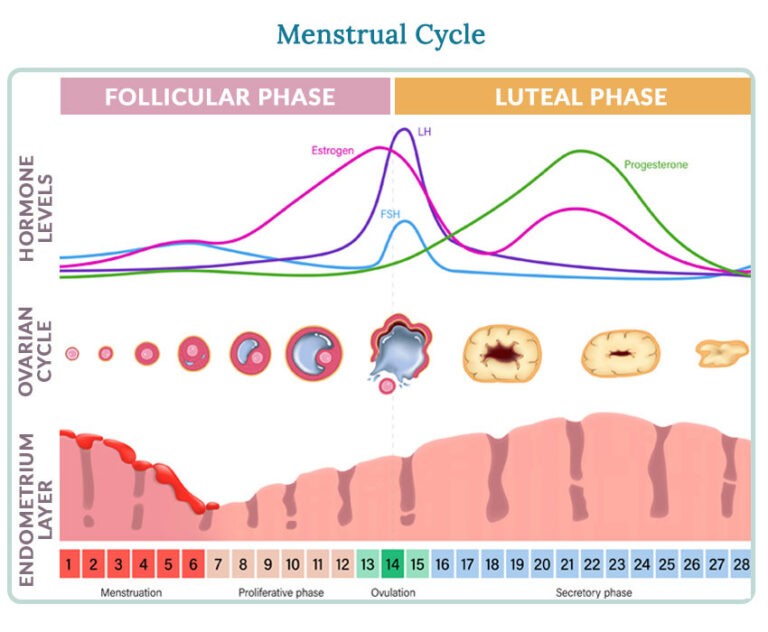
A menstrual cycle runs from the first day of one period to the first day of the next. Its average length is 28 days, although cycle length can change throughout life. Cycles are often irregular in the first years after menstruation begins and before menopause. The cycle allows an egg to mature and be released from an ovary, while preparing the uterus for implantation of an embryo. Based on events in the ovaries, it can be divided into three main stages:
- the follicular phase
- ovulation
- the luteal phase
Day one of the cycle is the first day of menstrual bleeding.
The follicular phase begins on the first day of the cycle. Menstruation is the shedding of the uterine lining, which causes menstrual bleeding. The follicular phase lasts until ovulation, which generally occurs around 14 days before the next period. Ovulation is the release of a mature egg from an ovarian follicle. The luteal phase lasts from ovulation until the next period begins.
The menstrual cycle and hormones
The menstrual cycle is regulated by hormones whose levels change cyclically.
Follicle-stimulating hormone (FSH) is produced by the pituitary gland. During the follicular phase, it stimulates the growth and development of ovarian follicles and supports oestrogen production.
Luteinising hormone (LH) is also produced by the pituitary gland. Its level rises around the middle of the cycle. LH supports oestrogen production, and its surge triggers the release of an egg from the ovary.
Gonadotropin-releasing hormone (GnRH), produced by the hypothalamus, stimulates the release of FSH and LH into the bloodstream.
Oestrogen supports egg maturation and helps prepare the uterus for pregnancy. As the egg matures, oestrogen levels rise, reaching a peak approximately two days before ovulation. The body produces three types of oestrogen: oestrone, oestradiol and oestriol.
Progesterone: after ovulation, the follicle becomes the corpus luteum and begins producing progesterone. This hormone prepares the uterine lining, or endometrium, for implantation of a fertilised egg. Progesterone levels rise significantly after ovulation.
Which hormones have the greatest effect on skin health?
Oestrogen influences skin structure, repair and barrier function. The most important oestrogen for the skin is oestradiol. It:
- supports collagen production and helps maintain skin structure
- influences skin thickness, elasticity and the ability to retain moisture
- contributes to barrier function and wound healing
- influences blood flow in the skin and the regulation of inflammation.
Falling oestrogen levels, particularly during menopause, are associated with thinner skin, reduced collagen, dryness and loss of elasticity. However, normal menstrual fluctuations have not been shown to make everyone’s skin noticeably drier or more elastic at a particular stage. A 2024 review found no significant difference in skin hydration between cycle phases, although skin elasticity was greater at ovulation than during the follicular phase.
Progesterone rises after ovulation and falls before menstruation if pregnancy does not occur. It:
- plays a part in regulating the skin’s hormonal environment and physiological processes
- often rises alongside changes in resting skin temperature and blood flow during the second half of the cycle
- may be associated with cyclical flare-ups of some inflammatory skin conditions, although the precise mechanism remains unclear.
During the luteal phase, skin temperature may rise. Some studies have also observed increased skin blood flow and sweating. Some women experience acne or eczema flare-ups before their period. These changes cannot be considered a direct, universal effect of progesterone: the overall hormonal environment and the individual’s skin response both matter.
Androgens, often called male sex hormones, are present in both women and men. They stimulate sebaceous gland development and sebum production. Excess sebum, together with blocked hair follicles and inflammation, can contribute to acne. This can appear as:
- oilier, shinier skin
- blocked pores and inflamed pimples
- acne.
FSH and LH are produced by the pituitary gland. They are not the main direct regulators of sebum production, but they govern the menstrual cycle and therefore influence the skin’s hormonal environment. Their effect on the skin is mainly indirect.
How can you ease hormone-related skin changes?
Hormonal skin concerns cannot always be prevented completely, but a consistent, gentle skincare routine can help. Wash your face with a mild cleanser up to twice a day. Washing too frequently, vigorous rubbing and harsh exfoliation can irritate the skin and damage its natural barrier. Moisturiser helps maintain hydration, including in acne-prone skin. Use broad-spectrum sun protection during the day and choose non-comedogenic products, which are less likely to clog pores.
If pimples and blocked pores are the main concern, products containing AHA or BHA acids may help as part of a suitable routine. Introduce these ingredients gradually, as overuse can cause dryness and irritation. Avoid squeezing pimples: this can increase inflammation and the risk of scarring and pigmentation changes.
It is also useful to track your skin throughout the menstrual cycle. A diary noting cycle phases and skin changes can help you spot recurring patterns and understand which skincare steps work best.
Hormonal skin concerns do not mean you are caring for your skin incorrectly. The aim is not to eliminate every natural change, but to ease symptoms and maintain skin health and barrier function.
Summary
Skin changes during the menstrual cycle are natural. They reflect hormonal fluctuations that affect everyone differently. Although pimples and increased oiliness cannot always be avoided, consistent, gentle care can help reduce their impact.
Listen to your skin, keep your routine simple and do not expect flawless skin every day of your cycle.
Your skin does not have to look the same every day to be healthy.
This article draws on scientific literature and patient information. Further reading on the menstrual cycle, hormones and skincare:
- University of Tartu digital repository: source material
- Review: physiological changes in women’s skin during the menstrual cycle (2024)
- East Tallinn Central Hospital: menstruation (in Estonian)
- Viljakusest.ee: menstruation, ovulation and menopause (in Estonian)
- American Academy of Dermatology: skincare tips for acne
 Kadaka tee 42b, 12915 Tallinn, 2nd floor
 Mon–Fri 09:00–17:00
 info@n8r.ee
 +372 59009272