


Introduction
Author: Laura Lorents
Korean cosmetics, glass skin and beauty products taking TikTok by storm — how can you identify the products among social media trends that might actually suit your skin?
Sometimes a single popular TikTok video is enough to put a product into thousands of shopping baskets. Before-and-after photos, promises of radiant skin and claims of quick results can make us feel that this particular product is what our skincare routine has been missing. But are “viral” products really as good as they appear on social media? Or are we sometimes buying into clever marketing?
A popular skincare product is not automatically bad, but its popularity does not prove that it works. What matters most is understanding your skin’s needs and knowing what to expect from a particular product.
Why can’t we always trust skincare advice on social media?
Skincare advice on social media comes from dermatologists and aesthetic medicine professionals, but also from beauty enthusiasts, content creators and people without expertise in how skin works, skin conditions or cosmetic chemistry.
Personal experience can be valuable: someone may report that their skin became brighter or clearer after using a product. However, one person’s results do not mean that the same product will work equally well for everyone else.
This does not mean that there is no good advice on social media. Rather, views, attractive packaging or persuasive advertising should not be our main criteria when choosing a product. Popularity is not the same as proven effectiveness. Although social media helps people discover products and learn about skincare, it can leave out important details: which ingredients actually work, what concentrations have been studied, and whether the visible result comes from the product or from other factors.
A review of research published in 2022 found that social media helps spread information about skin health, but that not all of this information is reliable. It is therefore worth checking whether claims about popular beauty products are supported by scientific evidence. The authors highlighted the need for informative, engaging and scientifically reliable dermatology content on social media.
This is also the thinking behind this blog post.
Which skincare trends and beauty products are gaining popularity on social media?
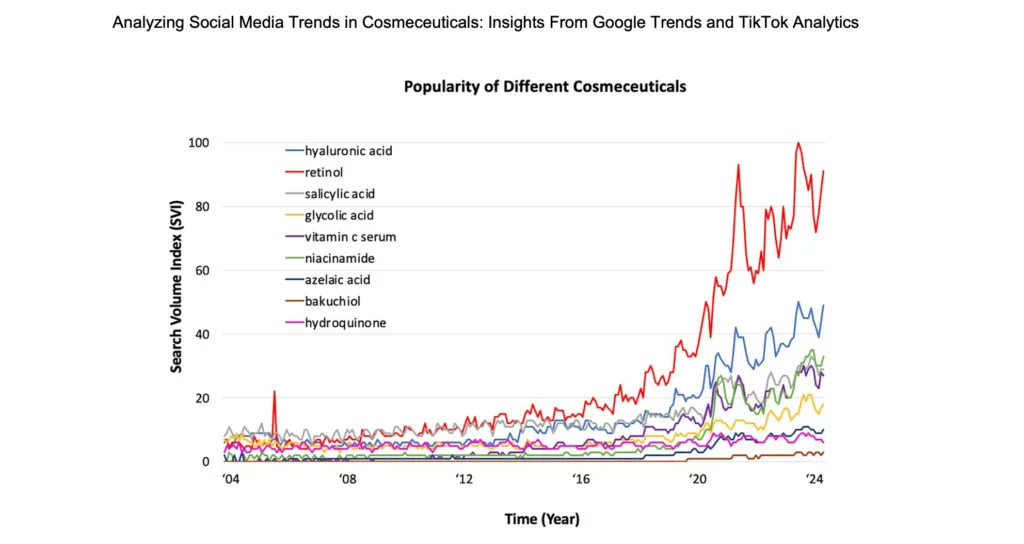
On TikTok and Instagram, both new skincare routines and products containing particular active ingredients attract attention with promises of intense hydration, brighter skin and a more even complexion. A study published in 2025, comparing Google search trends and TikTok views over the period 2004–2023, identified retinol, hyaluronic acid, salicylic acid, glycolic acid, vitamin C and niacinamide among popular skincare ingredients. These ingredients are associated with different skincare goals, such as hydration, acne management and improved skin texture.
However, a product’s popularity does not automatically mean that its effectiveness has been scientifically demonstrated or that it suits everyone. When considering beauty trends on social media, it is worth looking beyond popularity and examining what research says about the ingredients and products.
Alongside individual ingredients, product categories such as face masks, exfoliating acids, anti-acne products and moisturisers that support the skin barrier are also popular. Videos often show rapid changes in the appearance of the skin or personal experiences with a new product. This content may help people discover new skincare options, but lighting, filters, other products and individual differences between people’s skin can also affect the results.
Which skincare ingredient should you choose?
Which active ingredients may help with different skin concerns?
The same ingredients often appear in skincare products that become popular on social media, but each has its own purpose. Which might be useful for your skin?
Retinol — acne and uneven skin texture. Retinoids help treat acne and can also reduce the dark marks left by spots, making skin tone more even. They can irritate the skin, so it is important to introduce them cautiously.
Niacinamide (vitamin B3) — supporting the skin barrier and addressing uneven skin tone. Niacinamide helps strengthen the skin’s protective barrier, reduce excess oil production and redness, and even out skin tone. Results depend on the formulation and the concentration of the active ingredient.
Hyaluronic acid — dry skin. Hyaluronic acid helps bind moisture in the skin. On its own, however, it does not remove all wrinkles or address every cause of dry skin.
Salicylic acid — blocked pores and acne. Salicylic acid is used to exfoliate the skin and help with clogged pores and acne. It can cause dryness or irritation in sensitive skin.
Vitamin C — uneven skin tone and dark spots. Topical vitamin C may help reduce pigmentation and support the skin’s defence against oxidative stress. Results depend on the product’s formulation and stability.
Azelaic acid — acne, redness and pigmentation. Azelaic acid has anti-inflammatory properties and is used to treat skin concerns associated with acne and rosacea. It may also help reduce post-inflammatory hyperpigmentation. Compared with some stronger exfoliating ingredients, it may be better tolerated by some people, although stinging or irritation can still occur at first.
Even a well-studied ingredient does not guarantee the same result in every product. Its effect depends on the formulation, concentration, consistency of use and individual skin needs. Before buying a beauty product that has become popular on social media, it is therefore worth checking whether research supports its promises and whether it suits your skin.
Are popular beauty products worth trying?
Products that become popular on social media are neither necessarily bad nor automatically effective. The key is to understand what your skin actually needs. Before buying a new product, get to know your skin type and identify the concern: is it acne, rosacea, pigmentation, surface dryness or something else? A consultation with a dermatologist, dermatology nurse or aesthetic medicine professional can help clarify this.
Different skin concerns may require different ingredients, and a product that works wonderfully for one person may not give another person the same results. Advice from a dermatologist or qualified skincare professional can be helpful, but it is worth applying critical thinking to recommendations too. Doctors and beauty professionals may have commercial relationships or partnerships with manufacturers. Potential conflicts of interest should therefore be transparent, and recommendations should put the client’s needs first.
This does not mean that professional advice is unreliable. It means that decisions should take into account both the reasoning behind a recommendation and the available scientific evidence. You can certainly consider trying products that have become popular on social media, but do a little research first: look at the ingredients, seek reliable scientific sources and choose according to your skin’s needs, rather than trends alone. What matters most is not how popular a product is, but whether it suits your skin.
Summary
Before adding the next TikTok favourite to your basket, ask yourself: does it really suit my skin, or do I want it simply because everyone is talking about it? Popular products may be worth trying, but understanding your skin’s needs and examining the science behind the ingredients matter most. If you have acne, rosacea, pigmentation or another persistent skin concern, a consultation with an aesthetic medicine professional may help you find an appropriate approach.
Don’t choose a product just because it is trending — choose it based on knowledge, evidence and your skin’s needs.
This blog post draws on scientific articles. Further reading:
 Kadaka tee 42b, 12915 Tallinn, 2nd floor
 Mon–Fri 09:00–17:00
 info@n8r.ee
 +372 59009272