

Peptides – small molecules with a major role in skin health
Peptides have received increasing attention in skincare, wellness products and aesthetic medicine. This is due to their varied mechanisms of action. They are short chains of amino acids with important roles in supporting different biological processes. Peptides occur naturally in the body and help cells communicate with one another, affecting skin repair, collagen production and tissue renewal. These properties have made them an important area of interest.
Today, peptides are used in many fields, from daily skincare and wellness products to aesthetic treatments. They are valued for their varied effects, good tolerability and ability to support the natural processes of the skin and body.
This article explains what peptides are, how they work and why they have become an important part of skincare and aesthetic medicine.
Peptides
Peptides are short chains of amino acids that act as important signalling molecules in the body. In addition to cellular signalling, peptides play roles in enzyme and hormone activity and in immune-system function.
The simplest are dipeptides, which contain two amino acids, followed by tripeptides with three amino acids, and so on. A peptide chain containing more than 50 amino acids is called a protein. Chains with fewer than 20 amino acids are called oligopeptides.
Peptides regulate many bodily processes and systems at cellular and tissue level. The human body produces more than 7,000 different peptides, each with its own purpose. They can be grouped according to their mechanism of action.
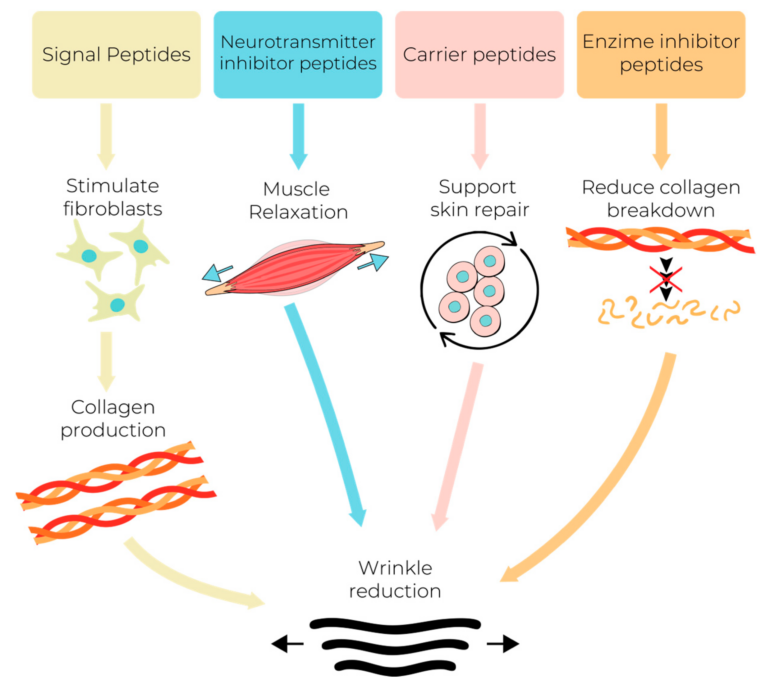
In cosmetics and aesthetic medicine, peptides are divided into four main groups:
- Signal peptides – used to stimulate fibroblasts, increase collagen production and improve skin elasticity.
- Carrier peptides – transport important trace elements into the skin.
- Neurotransmitter-inhibiting peptides – help relax facial muscles and minimise expression lines.
- Enzyme-inhibiting peptides – reduce collagen degradation and support the integrity of the skin.
Anti-ageing peptides
Around 250 peptides with anti-ageing mechanisms are currently known. Many support cellular repair and have antioxidant effects. A large proportion consist of 6–25 amino acids. As we age, the skin’s ability to produce collagen and elastin declines. The skin becomes thinner and drier, and fine lines and wrinkles develop. Peptides can send signals to skin cells that support firmness, elasticity and overall quality.
The most commonly used anti-ageing peptides are signal peptides that stimulate collagen synthesis. Matrixyl® (palmitoyl pentapeptide-4), for example, is a peptide complex used in skincare to improve texture and reduce the appearance of wrinkles. Another well-known cosmetic peptide is Argireline® (acetyl hexapeptide-8), often described as a ‘Botox-like peptide’. It affects nerve signalling and may help reduce expression lines, especially on the forehead and around the eyes. Copper peptides (GHK-Cu) are also popular and support skin repair and quality as well as collagen and elastin production.
Skincare products also use various biomimetic peptides. These imitate peptides that occur naturally in the body and can support hydration, strength and a youthful appearance.
Peptides in cosmetics and aesthetic medicine
Peptides have become an important part of modern skin-rejuvenation and repair treatments. They are used in professional facials and aesthetic medicine to improve skin quality, support collagen production and slow the appearance of signs of ageing. Regular, appropriately selected care helps keep the skin healthy, hydrated and youthful-looking.
Facials with peptides
Professional peptide facials are popular for their hydrating, soothing and anti-ageing effects. Serums, masks and ampoules containing peptides are often used to improve elasticity and support recovery. These treatments can suit the prevention of early signs of ageing, hydration, the revitalisation of dull and tired skin and support for sensitive skin.
The NOON Aesthetics™ chemical peel is a suitable option because exfoliation stimulates renewal, while the peptide serum massaged into the skin supports repair and improved quality.
Aesthetic treatments with peptides
Peptides are used in aesthetic medicine because they can effectively support the skin’s natural processes and improve quality from within.
Mesotherapy supplies the skin with selected active ingredients and improves its appearance. The treatment hydrates, softens fine lines and helps balance sebum production, making the skin appear brighter and more vital.
Biorevitalisation is a deep-hydration treatment using hyaluronic acid injections to rejuvenate the skin and improve its quality. It can improve elasticity and tone, hydrate the skin, restore radiance and smooth superficial lines.
Exosomes with microneedling use growth factors, signalling molecules and peptides to support recovery and collagen synthesis.
Summary
Peptides have become an important part of skincare and aesthetic medicine because of their ability to support natural processes in the skin. These short amino-acid chains can stimulate collagen production, improve elasticity and hydration and support repair and overall quality. Different types of peptide work at several levels, helping to reduce signs of ageing, strengthen the skin barrier and support a youthful appearance.
Regular, appropriately selected skincare combined with professional treatments can support the skin’s long-term health, radiance and youthful appearance.
This article is based on a scientific publication. Read more about peptides here:
 Kadaka tee 42b, 12919 Tallinn II korrus
 E-R 09.00 — 17.00
 info@n8r.ee
 +372 59009272